How to Get Recruiters to Contact You Instead of Chasing Every Opening
Want inbound job offers? Learn how to get recruiters to contact you with a searchable profile, a clear target role, and smart replies when they reach out.
 JobzseekerAI Team6 min read
Sending applications one by one is slow, and the silence that follows can be discouraging. There's another direction a job search can run: recruiters reach out to you. That doesn't happen by luck. It happens because your profile shows up when they search and gives them a clear reason to send a message.
If you've wondered how to get recruiters to contact you, the answer is less about being impressive and more about being findable and easy to understand. This guide explains how recruiters search for candidates, what makes them stop and reach out, and how to respond so a first message turns into a real conversation.
How Recruiters Find Candidates
Recruiters, whether they work inside a company or for an agency, spend a large part of their week sourcing. That means searching databases, professional networks, and talent platforms for people who fit an open role. A typical search combines a job title, a few must-have skills, a location or remote preference, and sometimes years of experience.
Then they scan the results quickly. A recruiter might look at dozens of profiles for a single role, deciding in seconds whether each one is worth opening. Two things drive that decision: whether your profile matched the search in the first place, and whether the first few lines make your fit obvious.
So the work splits into two parts. First, get into the search results. Second, make the click worth it.
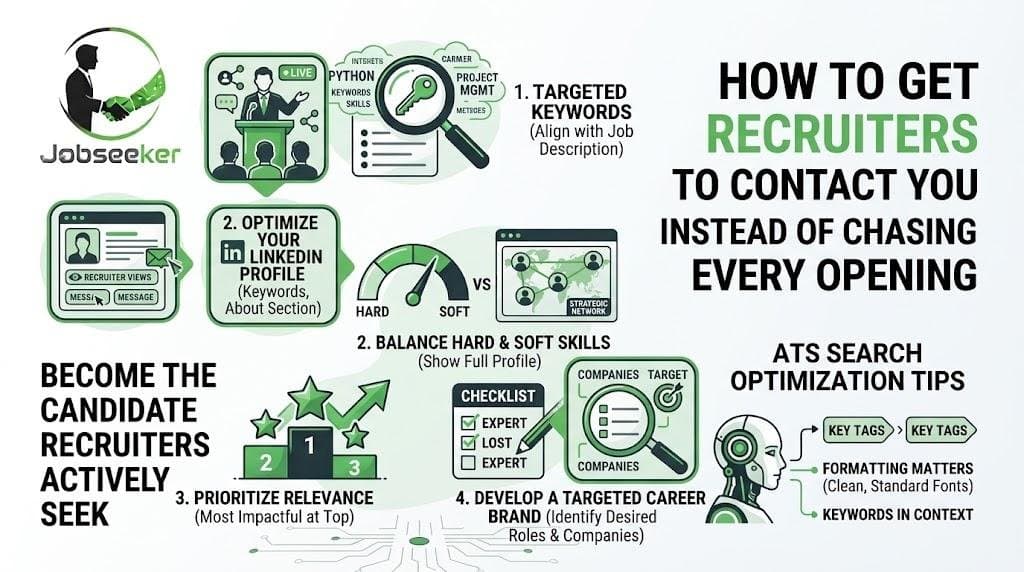
How to Get Recruiters to Contact You: Seven Practical Moves
1. Choose one clear target role
A profile that says "Marketing, Sales, Operations, Data, and Project Management" matches lots of searches weakly and none of them strongly. Pick the role you want next, and use the title recruiters actually search for. "Product Marketing Manager" will be found more often than "Storyteller and Growth Strategist."
2. Write your headline and summary in the recruiter's language
Your headline and professional summary are the first things a recruiter reads. They should answer three questions immediately: what you do, what level you're at, and what you're looking for. More on this in the next section.
3. State your location and work preferences plainly
Location filters are among the most common recruiter filters. List your city and state, and say whether you're open to remote work, hybrid work, or relocation. If it applies to you, note your US work authorization. Recruiters often skip profiles where this is unclear, simply because confirming it takes extra effort.
4. Name your skills the way job postings do
Recruiters search using the vocabulary from the job description they're hiring for. Mirror that vocabulary where it honestly describes you, and name specific tools rather than general categories. "Workday" and "ADP" will be searched far more often than "HR software."
5. Keep your profile current
A profile with your current role, recent projects, and an up-to-date skill set looks like someone who's engaged with their career. Set a reminder every few months to refresh it, even when you aren't actively looking.
6. Be visible in the places recruiters actually search
Professional networks are the obvious choice, but they're crowded. Industry associations, niche job communities, and talent marketplaces, where companies search candidate profiles directly, give you more places to be found. Each additional place that hosts a strong profile increases your chances of being discovered.
7. Make replying easy
Turn on notifications for the platforms you use and respond within a day or two. A recruiter with a role to fill often contacts several people at once. Fast, clear replies keep you in the running.
Writing a Professional Summary That Gets Recruiters to Reach Out
Your professional summary is two to four sentences, and it does most of the persuading. Compare these two versions:
Before:
"Passionate, results-driven professional seeking new challenges where I can grow and add value."
A recruiter learns nothing from this. There's no role, no level, no specialty, and no keywords.
After:
"Customer success manager with six years in B2B SaaS, managing a $3M portfolio of mid-market accounts. Experienced with Gainsight, Salesforce, and renewal forecasting. Open to remote or hybrid roles in the Denver area."
This version tells the recruiter the title, level, industry, scope, tools, and logistics in under 40 words. It also includes several terms a recruiter would likely search for.
Passive Job Search: Being Open Without Being Desperate
A passive job search means you're employed, or busy with school or freelance work, but open to the right opportunity. Recruiters often prefer passive candidates because they're currently doing the work. Your profile can signal openness without sounding urgent. A line such as "Open to conversations about senior data roles" works well.
The advantage of a passive approach is leverage. You can evaluate offers calmly, ask better questions, and say no to roles that don't fit.
How a Talent Marketplace Flips the Process
A talent marketplace is built for exactly this direction of search. On JobzseekerAI, you upload your resume once to create a free profile. Companies describe what they need, and the platform's matching ranks candidates against those requirements, adding a one-line explanation of each person's fit. You don't send applications. Companies come to you.
Two details matter for job seekers. First, companies initially see an anonymized card with your initials, role category, skills, experience, and location; the JobzseekerAI privacy policy explains that full contact details are shared only after a company chooses to unlock your profile. Second, once a company connects, a chat thread opens and an interview call can be scheduled in one step. You can read more about how matching and connections work on the homepage.
Every tip in this article applies here as well. A clear target role, specific skills, and a strong summary help any matching system, human or automated, understand where you fit.
How to Reply When a Recruiter Reaches Out
A good reply is short, interesting, and moves things forward. Here's a template:
"Hi Jordan, thanks for reaching out. The operations analyst role sounds like a strong fit with my supply chain background. Could you share the salary range and whether the role is hybrid or fully remote? I'm available for a call Tuesday or Thursday afternoon."
If the role isn't right, say so politely and briefly describe what you are looking for. Recruiters often have more than one opening, and a respectful "no" can lead to a better match later.
Watch for Recruiter Scams
Most recruiter outreach is legitimate, but job scams are common enough that caution is smart. Be wary of anyone who asks you to pay for training or equipment, sends a check and asks you to return part of it, requests your Social Security number or bank details before a formal offer, or conducts the entire "interview" by text message. When in doubt, look up the company independently and contact it through its official channels.
Frequently Asked Questions
Why aren't recruiters contacting me?
+
The most common reasons are an unclear target role, missing keywords, a vague summary, or unclear location and work preferences. Fix those first before changing anything else.
Is it okay to reach out to recruiters first?
+
Yes. A short, specific message about the type of role you want, with your resume attached, is perfectly appropriate. Just avoid sending the same generic message to dozens of people.
Should I tell recruiters my salary expectations?
+
It's usually better to ask for the role's range first. Several US states and cities require employers to disclose pay ranges in job postings, so the information may already be available.
Do agency recruiters charge job seekers?
+
Legitimate agency recruiters are typically paid by the hiring company, not by candidates. Requests for payment from you are a warning sign.
How long should I wait to follow up with a recruiter?
+
About a week after your last contact is reasonable. Keep the follow-up brief and restate your interest.
Let the Search Come to You
Getting recruiters to contact you is a matter of design, not chance. Choose one target role, describe yourself in the language employers use, make your logistics clear, and keep your profile in the places where hiring teams actually search. Then reply quickly and professionally when the messages arrive. If you'd like one more place to be found, JobzseekerAI's free job seeker profile lets companies discover you based on your skills.
Let the right work find you.
Upload your CV once. JobzseekerAI matches you with companies, and your contact details stay hidden until a company unlocks your profile.
Create your free profile