How to Job Search While Employed Without Putting Your Current Job at Risk
Learn how to job search while employed without risking your current role: protect your privacy, schedule interviews, handle references, and resign well.
 JobzseekerAI Team7 min read
Looking for a new job while working is the strongest position a job seeker can be in. You have income, you're current in your skills, and you can afford to be selective. It also comes with real risk. If your manager finds out before you're ready, the conversation you'd planned for months from now could happen tomorrow, on someone else's terms.
Learning how to job search while employed comes down to three things: keeping your search private, finding time for interviews without lying elaborately, and leaving well when the right offer arrives. Here's how to handle each one.
Set Your Ground Rules First
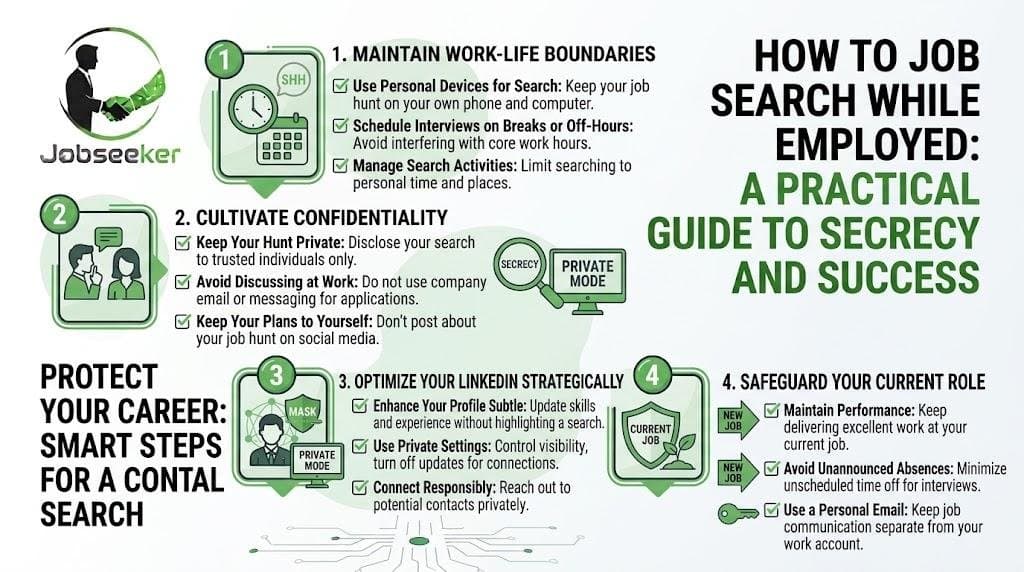
Most job searches that become public don't leak through gossip. They leak through small, avoidable habits. Before you send anything, commit to these rules.
Keep the search off company property
Don't use your work laptop, work email, work phone, or company network for anything related to your search. Many employers reserve the right to monitor their systems, and you shouldn't assume anything you do on them is private. Use your personal email, phone, and devices, on your own internet connection.
Don't search on the clock
Beyond the privacy risk, job hunting during work hours isn't fair to your current employer, and it's noticeable. Do your searching in the evenings, early mornings, or on weekends.
Review your employment agreements
Before you get far, reread any documents you signed when you were hired, including offer letters, non-compete or non-solicitation agreements, and confidentiality policies. These can affect which companies you can join and what you can take with you. Rules vary by state and by agreement, so if anything is unclear, consider asking an employment attorney.
Tell almost no one
Coworkers you trust may mean well, but news travels. Keep the circle to your partner, a mentor outside the company, and your references.
How to Job Search While Employed and Keep It Private Online
Your online presence is where a confidential job search is most likely to slip.
Update your profiles quietly
A sudden headline rewrite and five new skills on your professional networking profile can tip off colleagues. Many networking platforms let you turn off notifications about profile updates. Turn that setting off before making changes, and spread updates out over a few weeks.
Use "open to work" signals carefully
Some networks offer a setting that signals openness only to recruiters. These features can help, but platforms generally can't guarantee that recruiters at your own company, or recruiters who know your manager, won't see it. Treat it as reduced visibility, not invisibility.
Use anonymous job search tools
An anonymous job search lets employers evaluate your skills before they know who you are. On JobzseekerAI, companies first see an anonymized candidate card with your initials, role category, skills, experience, and location. According to the JobzseekerAI privacy policy, full contact details are shared only after a company explicitly unlocks your profile. The homepage also notes that job seekers can hide their profile or delete it at any time, which gives you an off switch if timing changes.
Be realistic about anonymity, though. In a small, specialized field, a combination of role, skills, and city can sometimes point to one person. If you work in a niche where that's a concern, keep your profile description a little more general until you're ready to be identified.
Watch where your resume goes
Uploading your resume to many open job boards increases the chance that a recruiter, or your own HR team, comes across it. Be selective, and favor platforms where you control who sees your details. You can review how JobzseekerAI keeps profiles anonymized by default before deciding whether it fits your situation.
How to Interview While Employed
Scheduling is usually the hardest practical part of a confidential job search.
Ask for flexible times
Early-morning, lunch-hour, and end-of-day slots work for many interviewers, especially for first-round calls. It's perfectly normal to say, "I'm currently employed, so early mornings or after 5 p.m. work best for me. Do any of those times work on your end?" Most hiring managers respect a candidate who protects their current employer's time.
Push for virtual early rounds
Video interviews make it much easier to step away briefly. Take them from home, your car, or a private space, never from your desk or a shared office. Save in-person visits for final rounds, and use paid time off for them when you can.
Keep explanations simple
You don't owe your current employer a detailed reason for every absence. "I have an appointment" is true and sufficient. Avoid elaborate stories. They're harder to keep straight, and they damage trust if they come apart.
Mind the wardrobe change
If your office is casual, showing up in a suit gives you away instantly. Change somewhere else, or dress in layers you can adjust.
Handling References While Employed
Ask prospective employers not to contact your current employer until you have an offer. This is a common request, and most recruiters understand it. Offer references from former managers, clients, or senior colleagues who've since left your company. If an employer insists on a current reference, it's reasonable to ask that the check happen only after a conditional offer.
If Your Boss Finds Out
Stay calm and don't deny it if it's true. A short, honest response is best: "I've been exploring what my long-term options look like. I'm committed to doing good work here while I figure that out." Then, if you're open to it, use the moment to discuss what would make you want to stay. Some of these conversations lead to better roles, raises, or new responsibilities.
Get the Offer in Writing Before You Resign
Never resign based on a verbal offer. Wait until you have a written offer and any conditions are cleared, such as a background check or drug screening. Then resign in person or on a video call, followed by a brief written letter.
Giving two weeks' notice
Two weeks' notice is common courtesy in the US. For most at-will employees it isn't a legal requirement, but your contract or company policy may specify a notice period, so check it. Use that time to document your work, train whoever takes over, and leave on good terms. Industries are smaller than they look, and the manager you leave today may be a reference or a colleague later.
Think carefully about counteroffers
If your employer offers more money to stay, consider why you started looking in the first place. If the reasons were about growth, culture, or management, a raise alone usually won't change them.
Common Mistakes to Avoid
- Saving job search files or applications on a work computer
- Listing your work phone or work email on applications
- Letting your current work slip while you search
- Complaining about your current employer in interviews
- Announcing your new role on social media before your last day
Frequently Asked Questions
Is it legal for my employer to fire me for looking for another job?
+
Most US employment is at-will, which generally means an employer can end employment for many reasons, including discovering a job search, as long as the reason isn't illegal discrimination or retaliation. Rules vary by state and contract, so consult an employment attorney with specific concerns.
How long does a job search while employed usually take?
+
It varies widely by field, level, and location. Because you're employed, you can afford a longer, more selective search. Pacing yourself matters more than speed.
Should I tell the new employer I'm searching confidentially?
+
Yes. Recruiters handle confidential searches all the time. Saying so upfront sets expectations about scheduling and references.
Can I list my current job on my resume during a confidential search?
+
Yes. It's expected. The privacy concern is about where your resume is posted, not what it contains.
What if I need to delete my profile from a job platform later?
+
Check the platform's privacy settings or policy. On JobzseekerAI, the homepage notes that you can hide or delete your profile anytime, and the privacy policy explains how to request account deletion. You can also contact the JobzseekerAI team with questions about your data.
Search Quietly, Leave Gracefully
A job search while employed rewards patience and discipline. Keep it off company systems, control who sees your profile, schedule interviews without elaborate cover stories, protect your current references, and resign only with a written offer in hand. Handle it that way, and you'll move to your next role with your reputation intact. If you'd like a discreet way to let employers find you, start with a free, anonymized job seeker profile on JobzseekerAI.
Let the right work find you.
Upload your CV once. JobzseekerAI matches you with companies, and your contact details stay hidden until a company unlocks your profile.
Create your free profile