How to List Skills on a Resume So Recruiters and Search Tools Notice
Learn how to list skills on a resume: which to include, how to group them, where they belong, and examples for different jobs and career changers.
 JobzseekerAI Team7 min read
Most skills sections fail in one of two ways. Some are so thin that a recruiter can't tell what you actually do. Others are a wall of 40 terms, from "Microsoft Word" to "machine learning," that leaves the reader wondering what you're truly good at.
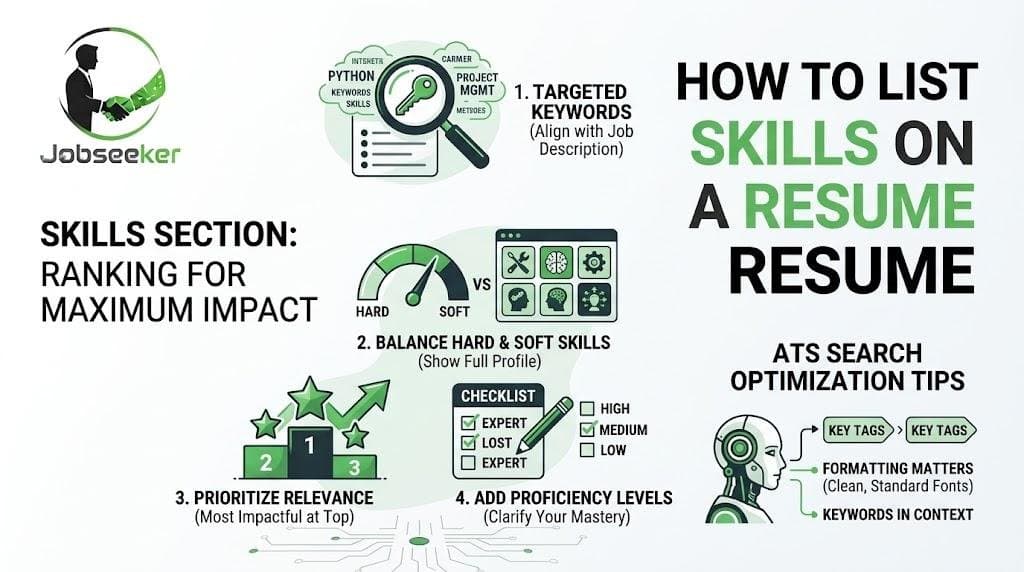
A strong skills section sits between those extremes. It's short enough to scan in a few seconds, specific enough to match what employers search for, and backed up by the rest of your resume. Learning how to list skills on a resume comes down to three decisions: which skills to include, how to organize them, and where to prove them.
Why Your Skills Section Has Two Readers
Your skills section is read by people and by software. A recruiter skims it to confirm you have the basics for the role. A search tool scans it, along with the rest of your resume, to match you with queries such as "SQL" or "OSHA 30."
Those two readers want slightly different things. Software rewards exact, recognizable terms. People reward relevance and credibility. The approach below serves both.
How to List Skills on a Resume in Five Steps
Step 1: Collect job description keywords
Open three to five postings for the role you want. Copy every skill, tool, and qualification they mention into a simple list, and put a tally mark beside each one every time it repeats. After a few postings, a pattern appears. The terms with the most tally marks are your priority keywords.
This exercise also shows you the employer's vocabulary. If every posting says "customer success" and your resume says "client happiness," you're using words nobody searches for.
Step 2: Keep only what you can defend
Cross off anything you couldn't discuss confidently in an interview. If you used Tableau once in a class two years ago, it doesn't belong in your skills section. Every skill you list is an invitation for a follow-up question.
Step 3: Group your skills by type
A single comma-separated list of 25 items is hard to read. Group skills into two to four labeled categories that make sense for your field, such as "Software," "Languages," "Certifications," or "Methods."
Step 4: Put the most relevant skills first
Within each group, lead with the skills that matched the most postings. Recruiters skim from left to right and top to bottom, so order signals priority.
Step 5: Prove your top skills elsewhere
The skills section makes a claim. Your experience bullets provide the evidence. Each of your three to five most important skills should appear at least once in a bullet that shows results, such as "Automated weekly sales reporting in Python, saving the team about five hours a week."
Hard Skills vs Soft Skills: Where Each One Belongs
Hard skills are teachable, measurable abilities: Excel, AutoCAD, phlebotomy, forklift operation, Spanish, or financial modeling. Soft skills are interpersonal and behavioral: communication, leadership, adaptability, and problem-solving.
The hard skills vs soft skills question has a practical answer. Hard skills belong in your skills section because they're specific and searchable. Soft skills usually work better when they're shown in your experience. Listing "strong communicator" proves nothing. Writing "Presented quarterly results to a 60-person leadership team" proves it without using the word at all.
There are exceptions. If a posting repeatedly asks for a specific interpersonal skill, such as "conflict resolution" for a customer service role, it's reasonable to include that exact phrase once.
Formatting Your Resume Skills Section: Examples by Role
The right format depends on your field. Here are three examples you can adapt.
Example: Software developer
Languages: Python, TypeScript, SQL
Frameworks: React, Django, FastAPI
Tools & Cloud: Git, Docker, AWS (EC2, S3, Lambda)
Example: Registered nurse
Licenses & Certifications: RN (Texas), BLS, ACLS
Clinical: Telemetry monitoring, IV therapy, wound care, patient education
Systems: Epic EHR
Example: Marketing coordinator
Platforms: HubSpot, Google Analytics 4, Meta Ads Manager, Canva
Skills: Email marketing, SEO content, A/B testing, social media scheduling
Languages: English (native), Spanish (professional working proficiency)
Notice what's missing: skill bars, star ratings, and percentages. A bar showing you're "80% proficient" in Excel raises more questions than it answers. If proficiency matters, use words or context instead, such as "Excel (pivot tables, XLOOKUP, Power Query)."
Technical skills on a resume: how specific to get
Be specific enough to match a search, but don't list every feature of a tool. "AWS" alone is vague. "AWS (EC2, S3, Lambda)" tells a recruiter which services you've actually used. Listing 15 AWS services, on the other hand, starts to look like padding.
Skills-Based Resumes and Transferable Skills for Career Changers
If you're changing careers, your job titles may not match the role you want, so your skills have to carry more weight. Start by identifying transferable skills: abilities you've used in past roles that the new field also needs.
A teacher moving into corporate training already has curriculum design, presentation, and assessment skills. A retail manager moving into operations already has scheduling, inventory control, and staff training experience. Translate these into the new field's language, using the job description keywords you collected in Step 1.
Some career changers choose a fully skills-based resume, also called a functional resume, which groups experience by skill rather than by job. Many recruiters find that format frustrating because it hides when and where you did the work. A hybrid format is usually safer: a detailed skills summary at the top, followed by a standard reverse-chronological work history.
Common Skills Section Mistakes
- Listing outdated basics. For most professional roles, "Microsoft Word" and "email" are assumed. Use that space for something that sets you apart.
- Copying the job posting wholesale. Matching keywords is smart. Pasting the entire requirements list is obvious and unconvincing.
- Using one generic list for every application. Reorder and adjust your skills for each type of role you apply to.
- Hiding skills in graphics. Icons and charts can be invisible to search tools.
Where Your Skills Section Goes
For most experienced candidates, the skills section sits after work experience or in a compact block near the top, under the summary. Students and career changers often benefit from placing it higher, directly below the summary, because skills are their strongest selling point.
How Skills Count in Matching on JobzseekerAI
On JobzseekerAI, skills matter, but they don't stand alone. The Smart Matcher's hybrid search weighs semantic fit at 70%, specific skills at 20%, and experience at 10%. In plain terms, the overall meaning of your profile counts more than a keyword list. That's the same lesson as Step 5: a skill that appears in context, inside a real accomplishment, tells a fuller story than a skill listed by itself.
When companies browse candidates, the anonymized candidate cards show your top skills next to your role category and experience, before any personal details. That makes your skills section one of the first things a hiring team sees. If your resume is ready, you can upload it to a free profile in a couple of minutes.
Frequently Asked Questions
How many skills should I put on a resume?
+
For most people, 8 to 15 well-chosen skills is a practical range. Technical roles may justify more if they're grouped clearly. Quality and relevance matter more than the count.
Should I include soft skills at all?
+
Yes, but mostly through your experience with bullets. Include a soft skill in your skills section only when the job posting emphasizes that exact phrase.
Can I list skills I'm still learning?
+
You can, as long as you're honest about the level. Label it clearly, for example "Python (beginner, completing coursework)," or list a relevant course under education.
What are the best skills to put on a resume?
+
The best skills to put on a resume are the ones that appear repeatedly in postings for your target role and that you can demonstrate. There's no universal list. A skill that's essential for a data analyst is irrelevant for a dental hygienist.
Should I list languages in the skills section?
+
Yes. Include the language and your level, such as "conversational," "professional working proficiency," or "native." Bilingual ability is a sought-after skill in many US roles.
Build a Skills Section That Earns Its Space
A good skills section is a short, organized promise, and the rest of your resume keeps that promise. Start with the employer's vocabulary, keep only what you can defend, group and order your skills deliberately, and prove the most important ones in your experience. Do that, and both the recruiter skimming your resume and the search tool scanning it will find what they're looking for.
Let the right work find you.
Upload your CV once. JobzseekerAI matches you with companies, and your contact details stay hidden until a company unlocks your profile.
Create your free profile