How to Negotiate Salary After a Job Offer Without Risking It
Learn how to negotiate salary after a job offer: research your range, make a confident counter offer, and use our phone script and email template.
 JobzseekerAI Team8 min read
The offer call comes in, the recruiter shares a number, and your first instinct is to say yes before anyone changes their mind. That reaction is understandable. After weeks or months of searching, an offer feels fragile.
But the offer stage is when you have the most leverage you'll have with this employer. They've already chosen you, invested time in interviews, and stopped seriously considering other candidates. A respectful negotiation is a normal part of hiring in the US, and many employers expect it. This guide walks through how to negotiate salary after a job offer, including how to research your number, what to say, and what to do if the base pay won't move.
Is It Safe to Negotiate a Job Offer?
For most roles, a polite, well-reasoned request is unlikely to cost you the offer. Employers rescinding an offer simply because a candidate asked for more is uncommon, especially when the request is professional and grounded in research. That said, nothing is guaranteed, and there are situations where flexibility is limited, such as union positions, government jobs with fixed pay scales, and some structured graduate programs.
The real risk usually isn't negotiating. It's negotiating badly: making demands, bluffing about other offers, or dragging the process out for weeks.
How to Research Salary Range Before You Respond
Negotiation without data is just guessing. Before you respond, gather a few reference points.
- Government data. The US Bureau of Labor Statistics publishes median pay and wage ranges for hundreds of occupations, broken down by state and metro area.
- Job postings. A growing number of states and cities, including California, Colorado, New York, and Washington, require many employers to include pay ranges in their postings. Look at similar roles in your area to see where the market sits.
- Salary comparison sites. Self-reported salary data can be uneven, but looking at several sources together gives you a rough picture.
- People in your field. Recruiters, former colleagues, and professional groups are often willing to share typical ranges, even if they won't share their own pay.
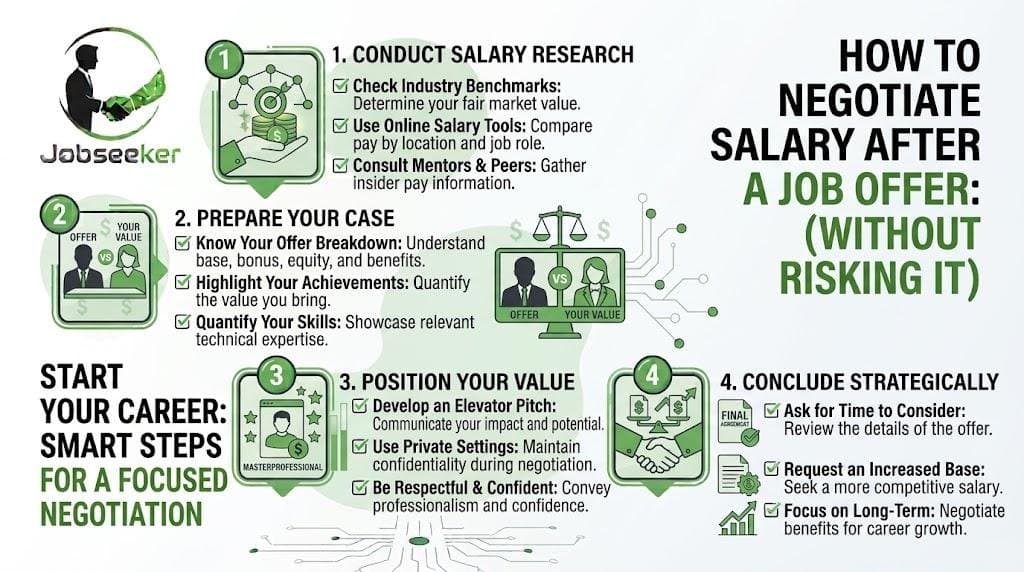
From that research, set three numbers for yourself: your walk-away point (the lowest you'd accept), your target (what you realistically hope to get), and your ask (a figure slightly above your target, leaving room to meet in the middle).
Remember to look at total compensation, not just salary. Health insurance costs, retirement matching, bonus structure, paid time off, and remote work can make two offers with the same base pay feel very different.
How to Negotiate Salary After a Job Offer, Step by Step
1. Thank them and ask for time
You don't need to respond on the spot. Express genuine enthusiasm, then ask for a day or two to review the details: "Thank you, I'm really excited about this. Could I have until Thursday to look over the full offer?" Ask for the offer in writing so you can review benefits and terms carefully.
2. Make a specific counter offer
When you respond, name a specific number rather than asking "Is there any flexibility?" A precise counter offer, such as $78,000 instead of "around 80," shows that you've done your research. Base your number on market data and on what you bring, not on personal expenses like rent or student loans.
3. Support your number with value
Briefly explain why your request makes sense. Point to the market range you found, relevant certifications, specialized skills, or results you've delivered in previous roles. Keep it to two or three reasons. A long list can start to sound defensive.
4. Listen and stay flexible
After you state your number, stop talking and let them respond. The recruiter may agree, meet you partway, or say they need to check with the hiring manager. If they can't move on salary, ask whether other parts of the offer have room. Stay friendly throughout. You'll be working with some of these people soon.
5. Get the final terms in writing
Once you agree, ask for an updated offer letter that reflects the new salary and any other changes. Don't resign from your current job until you have it.
Salary Negotiation Script for a Phone Call
Many negotiations happen by phone or video. Here's a salary negotiation script you can adapt:
"Thank you again for the offer. I'm excited about the role and the team, and I'd like to make this work. Based on my research into similar roles in this area and the experience I'd bring with vendor management and budgeting, I was hoping for a base salary closer to $78,000. Is there any room to move toward that number?"
Then pause and wait. If the call happens over video, our virtual interview tips on camera setup and audio apply here as well.
Salary Negotiation Email Template
Some people prefer to negotiate in writing, and that's perfectly acceptable. A salary negotiation email gives you time to choose your words and gives the employer something concrete to take to decision-makers.
Subject: Operations Coordinator offer – follow-up
Hi Daniel,
Thank you for sending over the offer for the Operations Coordinator position. I'm excited about the opportunity and the work your team is doing.
After reviewing the details and comparing similar roles in the Denver area, I'd like to ask whether there's flexibility on the base salary. Given my four years of experience coordinating logistics and my background with inventory software, I believe a salary of $68,000 would better reflect the value I'd bring to the team.
I'm confident this role is a great fit, and I'm looking forward to finding something that works for both of us.
Best regards,
Maria Gonzalez
What to Say When Asked Salary Expectations Earlier
The salary question often comes up long before an offer, sometimes in the first recruiter screen. Many states and cities restrict employers from asking about your salary history, but asking about your expectations is generally allowed.
If you know the range from the posting, you can acknowledge it: "I saw the posted range of $65,000 to $75,000, and that works for me depending on the full benefits package." If you don't know the range, it's reasonable to ask first: "Could you share the budgeted range for this role?" If you're pressed for a number, give a researched range where the bottom is a figure you'd genuinely be happy with.
Negotiate Benefits When Salary Won't Move
Sometimes base pay is truly fixed by a budget or pay band. That doesn't end the conversation. You can often negotiate benefits and terms such as:
- A one-time signing bonus
- Additional paid time off
- Remote or hybrid work days
- A later or earlier start date
- A formal salary review after six months instead of a year
- Budget for training, certifications, or conferences
- A more accurate job title
Pick one or two that matter most to you rather than asking for everything at once.
How to Negotiate Salary for Your First Job
Entry-level candidates often assume negotiation is off limits. You may have less room to move, especially in structured programs where every new hire receives the same pay. But it rarely hurts to ask politely, particularly if you have internship experience, an in-demand skill, or a competing offer.
When you negotiate salary for first job offers, keep your request modest and well supported. A request for a few thousand dollars more, or for a signing bonus to cover relocation, is reasonable. If the answer is no, thank them and decide based on the offer as it stands.
Negotiation Mistakes to Avoid
- Inventing a competing offer. If they ask for details or call your bluff, you lose credibility and possibly the offer.
- Issuing ultimatums. "I need $90,000 or I'm walking away" turns a conversation into a standoff.
- Negotiating after you've accepted. Once you've said yes, reopening terms damages trust.
- Focusing on personal finances. Employers set pay based on the role and market, not your monthly expenses.
- Accepting before reviewing benefits. A strong salary paired with expensive health insurance can be a smaller raise than it looks.
If Your Current Employer Makes a Counteroffer
When you resign, your current employer may offer a raise to keep you. Before you accept, think about why you started looking in the first place. Money rarely fixes problems with management, growth, or the work itself. Our guide on how to job search while employed covers how to resign professionally and handle that conversation.
Your negotiation leverage also starts earlier than the offer stage. Being matched with roles that genuinely fit your skills puts you in a stronger position, because the employer is more confident you can deliver. On JobzseekerAI, companies find candidates through skill-based matching and connect through a built-in chat, which also gives you a written record of what's been discussed. Read about getting recruiters to contact you or create a free job seeker profile to get started.
Frequently Asked Questions
How much should I ask for when negotiating?
+
There's no fixed percentage that applies everywhere. Base your request on market research for your role, location, and experience. Many people aim a little above their target so there's room to settle in the middle.
Is it better to negotiate by phone or email?
+
Both are acceptable. A phone call can feel more personal and lets you read the other person's reaction. Email gives you time to choose your words carefully. Use whichever lets you communicate most clearly.
Can an employer withdraw an offer if I negotiate?
+
It's possible, but it's uncommon when the request is polite and reasonable. Offers are more likely to be withdrawn because of aggressive tactics, false claims, or long delays.
Should I negotiate if the offer already meets my expectations?
+
That's your call. If the offer matches your research and you're happy with it, accepting is perfectly fine. If there's one specific item that matters to you, such as remote days or start date, it's reasonable to ask about it.
How long should negotiation take?
+
Usually a few days. Respond to the initial offer within the time frame you agreed on, and aim to wrap up the whole conversation within a week.
Ask With Confidence
Learning how to negotiate salary after a job offer comes down to preparation and tone. Research your market value, decide on your numbers before the conversation, make one clear and specific request, and stay open to other forms of value if salary is fixed. The employer already wants to hire you. A calm, professional negotiation simply helps you start the job on terms that reflect what you bring.
Let the right work find you.
Upload your CV once. JobzseekerAI matches you with companies, and your contact details stay hidden until a company unlocks your profile.
Create your free profile