How to Answer "Tell Me About Yourself" in an Interview
Learn how to answer "tell me about yourself" with a simple present-past-future structure, sample answers for every career stage, and mistakes to avoid.
 JobzseekerAI Team9 min read
It sounds like the easiest question you'll get. It's about you, after all, and nobody knows that subject better. Yet "tell me about yourself" trips up plenty of candidates, because the prompt is so open that it's easy to wander. Some people start with where they grew up. Others recite every job on their resume. Others give a nervous ten-second answer that leaves the interviewer with nothing to work with.
Since it's usually the first question, your answer sets the tone for everything after it. Done well, it gives the interviewer a clear picture of who you are professionally and why you're in that chair. Here's how to answer tell me about yourself using a simple structure, with sample answers for different career stages.
What the Interviewer Is Really Asking
Interviewers rarely want your life story. Behind the question sit a few practical ones: What do you do now? What have you done that matters for this job? Why are you interested in this role? Your answer also shows how you communicate, including whether you can organize your thoughts and speak with some confidence.
Think of it as a short professional introduction, not a biography. Everything you say should connect, at least loosely, to the job in front of you.
How to Answer Tell Me About Yourself With the Present-Past-Future Formula
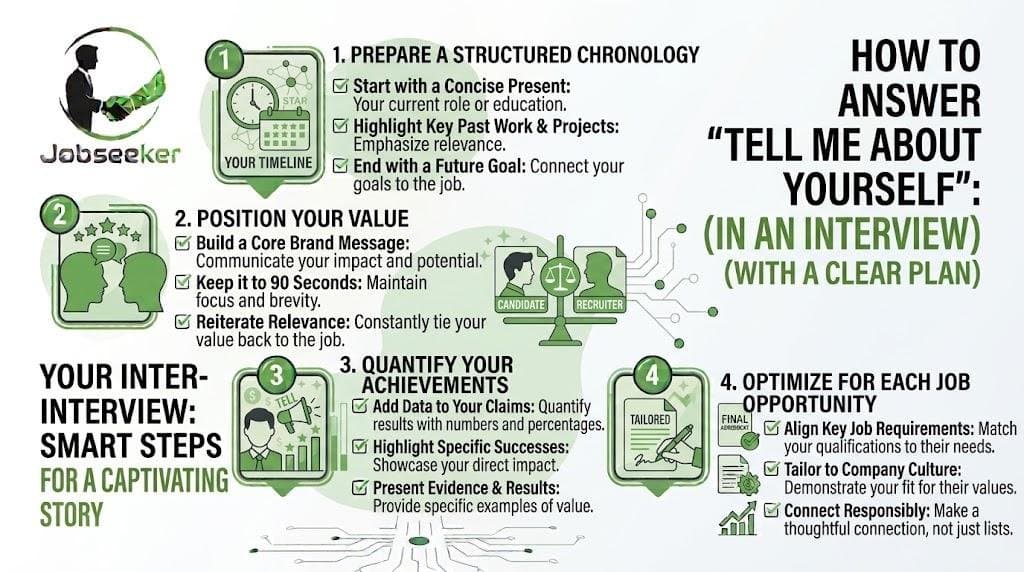
Career coaches recommend the present-past-future formula for a good reason: it's easy to remember under pressure, and it keeps you from drifting off topic.
Present: where you are now
Open with your current role or situation, plus one detail that shows what you're good at. For example: "I'm a customer success specialist at a mid-sized software company, where I manage about 60 small-business accounts."
If you're a student, your present is your studies and any relevant work: "I'm finishing my accounting degree and have spent the past year interning at a local CPA firm."
Past: what brought you here
Pick one or two experiences that explain how you built the skills this job needs. Choose highlights, not your entire resume. "Before that, I spent three years in retail, which is where I realized I enjoy solving customers' problems more than selling to them."
Future: why this job
Finish by connecting your story to the role. "Now I'm looking for a position where I can work with larger accounts and help shape onboarding, which is why this role caught my attention."
Many candidates skip this last part, and it's the one that matters most. It turns a description of yourself into a reason to keep talking to you.
How Long Your Answer Should Be
Aim for roughly 60 to 90 seconds. Under 30 seconds usually feels thin, and past two minutes the interviewer may start tuning out. If they want more detail, they'll ask, which is exactly what you want. A good answer opens a conversation rather than replacing one.
Tell Me About Yourself Sample Answers
Use these as models for structure, not scripts to memorize. Swap in your own experiences, and only use numbers you can stand behind.
Tell me about yourself for entry level candidates
"I recently graduated with a degree in communications. During my last two years of college, I worked part-time in the campus marketing office, where I wrote posts for the university's social media accounts and helped plan events for new students. My favorite project was our orientation week campaign, because I got to see an idea go from a planning doc to a packed event. That's when I realized I enjoy the coordination side of marketing as much as the writing. I'm excited about this coordinator role because it combines both, and I'd be learning from a team that runs much larger campaigns than I've worked on."
Notice that this answer uses school and part-time work as real experience. If you're early in your career, that's exactly what you should do. Our guide on how to list skills on a resume can help you identify which of those skills deserve the spotlight.
Sample answer for an experienced professional
"I'm a project manager with about eight years in construction. Right now I oversee commercial builds for a regional general contractor. I started out as a site engineer, and moving into project management showed me that my real strength is keeping schedules realistic and getting subcontractors aligned early. Last year my team delivered a medical office building three weeks ahead of schedule. I'm interested in this role because your company is growing its healthcare projects, and that's the area where I want to keep building my experience."
Tell me about yourself for a career change
"For the past six years I've taught high school math. A big part of that job was designing lessons, tracking student data, and adjusting my approach based on what the numbers showed. A couple of years ago I started learning SQL and Tableau to analyze my own classes' results, and I enjoyed it enough to complete a data analytics certificate this spring. I'm applying for this junior analyst role because it lets me do that work full-time, and years of explaining hard concepts to teenagers should help when I'm presenting findings to non-technical teams."
When you're switching fields, address the change directly and keep it positive. Lead with transferable skills, mention the concrete steps you've taken, and spend more time on where you're going than on what you're leaving. If you're still employed while interviewing, our article on how to job search while employed covers how to keep your search discreet.
Adjusting Your Answer for Different Interview Formats
Phone screens and recruiter calls. Keep it closer to 45 seconds. Recruiters are usually checking basic fit, so focus on your current role, your core skills, and what you're looking for next.
Panel interviews. Different panelists care about different things. A hiring manager may want to hear about results, while a future teammate may care more about how you collaborate. A brief mention of both covers the room.
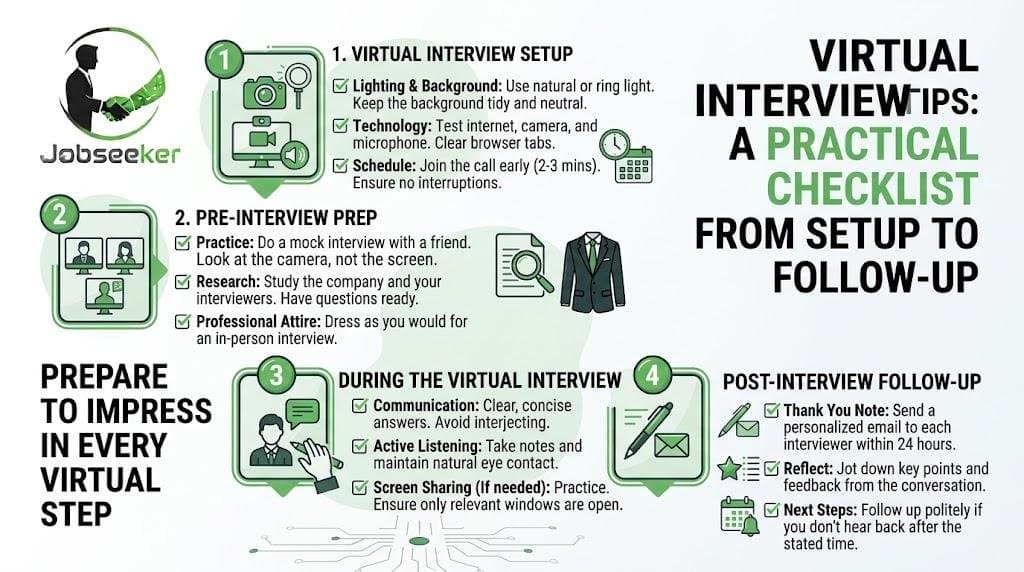
Video interviews. Look at the camera rather than the screen when you deliver your opening, and keep any notes off to the side so you aren't visibly reading. These virtual interview tips cover lighting, audio, and setup.
Networking events and career fairs. Your elevator pitch for a job interview and your networking introduction can share the same core. For networking, cut it down to about 30 seconds: who you are, what you do, and what kind of role you're exploring.
Mistakes That Weaken Your Answer
- Reciting your resume. The interviewer has already read it. Your answer should add context and connect the dots, not repeat dates and titles.
- Oversharing personal details. A brief mention of a relevant hobby is fine. Family plans, health, religion, and politics have nothing to do with your qualifications and pull the focus away from them.
- Criticizing a current or former employer. Even when it's deserved, it makes interviewers wonder how you'd talk about them later.
- Sounding memorized. A word-for-word script tends to come out flat, and if you lose your place, it's hard to recover.
- Relying on empty adjectives. "I'm a hard worker and a people person" says very little. One specific example says much more.
- Skipping the ending. If you never explain why this job, the interviewer has to guess.
How to Introduce Yourself in an Interview So It Sounds Natural
Preparation is what makes an answer sound relaxed. Try this process:
- 1Write three or four short bullet points, one for the present, one or two for the past, and one for the future. Bullets, not full sentences.
- 2Reread the job posting and circle the two or three requirements that matter most. Make sure your bullets touch on them.
- 3Say your answer out loud and record it on your phone. Listen for filler words, rushed sections, and places where you lose the thread.
- 4Adjust the "future" section for each company. The present and past can stay mostly the same; the reason you want this particular job should not.
- 5Have one short follow-up story ready, because a strong introduction often leads to "tell me more about that."
It also helps to make sure your CV and your spoken introduction tell the same story. When you upload your CV to JobzseekerAI, the CV Categorizer extracts your skills and experience, writes a short two-line summary, and assigns you a role category. Companies use that information to judge fit before they reach out, so your CV should lead with the same strengths you plan to emphasize in interviews. When a company does connect with you, the platform's chat and Google Meet scheduling features can move things to a real conversation quickly, and "tell me about yourself" may be the first thing you hear on that call.
Common Interview Questions That Build on This One
Your opening answer often shapes the next few questions, so keep your story consistent. "Walk me through your resume" asks for a longer, more chronological version of the same answer. "Why do you want this job?" expands on your future section. "What are you looking for in your next role?" and "Why are you leaving your current job?" test whether your reasons hold together. If your introduction is clear, these common interview questions become much easier to answer, because you've already laid the foundation.
Frequently Asked Questions
Is "walk me through your resume" the same question?
+
They're close. "Walk me through your resume" usually invites a slightly longer, more chronological answer, while "tell me about yourself" leaves you more freedom to choose what to highlight. The same present-past-future structure works for both.
Should I mention hobbies or personal interests?
+
Only briefly, and ideally when they connect to the job or show a relevant quality. Running marathons can hint at discipline; a long description of your weekend plans won't help.
How do I handle an employment gap in my answer?
+
You don't need to bring it up in your introduction. If it comes up, explain it in a sentence, mention anything useful you did during that time, and move back to why you're a fit for the role.
Should I memorize my answer word for word?
+
No. Memorize the structure and the key points, then practice saying them in slightly different ways. That keeps you sounding natural and makes it easier to recover if you get interrupted.
What if the interviewer asks this question later, not at the start?
+
Give the same core answer, but keep it shorter, since they've already heard part of your story. Focus on anything you haven't covered yet and on why you want the job.
Bringing It Together
Learning how to answer "tell me about yourself" is really about editing. You're choosing the few parts of your story that matter most for this job and arranging them so they lead naturally to one conclusion: you're a strong fit. Start with where you are now, pull in one or two experiences that got you here, and finish with why this role makes sense as your next step. Draft your bullet points tonight, practice them out loud a few times, and you'll walk into your next interview with a confident first answer ready to go.
Let the right work find you.
Upload your CV once. JobzseekerAI matches you with companies, and your contact details stay hidden until a company unlocks your profile.
Create your free profile